Benchmarks and verification
Random-intercept Gaussian ML scale validation and performance
The release PHP extension, R lme4 lmer and Python statsmodels MixedLM fit identical synthetic observations, with marginal ML (not REML), one random intercept and plug-in GLS fixed-effect inference. The raw report records versions, machine/thread settings, artifact/data hashes and every measurement.
Recorded results
from pathlib import Path
import json,sys
import pandas as pd
ROOT=next(p for p in [Path.cwd(),*Path.cwd().parents] if (p/'Cargo.toml').exists())
report=json.loads((ROOT/'docs/benchmarks/lmm-results.json').read_text())
assert report['model']=='lmm'
print('Recorded:',report['recorded_at'],'Machine:',report['cpu'],report['platform'])
print('Repeats:',report['repeats'],'Warm-ups:',report['warmups'])
print('Tolerance policy:',report['tolerance'])
def ordered_table(rows):
    table=pd.DataFrame(rows)
    table['implementation']=pd.Categorical(table['implementation'],categories=['R','statsmodels','PHP'],ordered=True)
    return table.sort_values(['observations','coefficients','implementation']).reset_index(drop=True)
rows=[];memory=[]
for case in report['cases']:
    assert case['agreement_passed']
    for name,fit in case['implementations'].items():
        rows.append(dict(observations=case['n'],coefficients=case['p'],groups=case['data']['n_groups'],implementation=name,version=fit['version'],median_fit_ms=1000*fit['median_fit_seconds'],minimum_fit_ms=1000*fit['min_fit_seconds']))
        memory.append(dict(observations=case['n'],coefficients=case['p'],implementation=name,CSV_load_seconds=fit['load_seconds'],whole_process_seconds=fit['process_seconds'],peak_RSS_MiB=fit['peak_rss_bytes']/2**20 if fit['peak_rss_bytes'] else None))
display(ordered_table(rows))
Recorded: 2026-10-11T20:47:02.703831+00:00 Machine: Apple M5 Ultra macOS-27.0.1-arm64-arm-64bit-Mach-O
Repeats: 5 Warm-ups: 1
Tolerance policy: {'absolute': 1e-07, 'relative': 1e-06, 'quantity_relative': {'covariance': 1e-05, 'std_errors': 1e-05, 'z_statistics': 1e-05, 'residual_variance': 1e-05, 'random_intercept_variance': 1e-05, 'sigma': 1e-05, 'icc': 1e-05, 'log_likelihood': 1e-09, 'aic': 1e-09}}| observations | coefficients | groups | implementation | version | median_fit_ms | minimum_fit_ms | |
|---|---|---|---|---|---|---|---|
| 0 | 1000 | 3 | 50 | R | R version 4.6.1 (2026-06-24) lme4 2.0.6 | 6.000000 | 6.000000 |
| 1 | 1000 | 3 | 50 | statsmodels | 0.15.0 | 13.778208 | 13.577292 |
| 2 | 1000 | 3 | 50 | PHP | 8.5.10 | 0.288584 | 0.284792 |
| 3 | 100000 | 3 | 100 | R | R version 4.6.1 (2026-06-24) lme4 2.0.6 | 229.000000 | 226.000000 |
| 4 | 100000 | 3 | 100 | statsmodels | 0.15.0 | 129.333333 | 128.906750 |
| 5 | 100000 | 3 | 100 | PHP | 8.5.10 | 13.142458 | 12.749875 |
| 6 | 100000 | 11 | 100 | R | R version 4.6.1 (2026-06-24) lme4 2.0.6 | 406.000000 | 379.000000 |
| 7 | 100000 | 11 | 100 | statsmodels | 0.15.0 | 244.483292 | 244.024458 |
| 8 | 100000 | 11 | 100 | PHP | 8.5.10 | 34.290750 | 33.606708 |
| 9 | 1000000 | 3 | 100 | R | R version 4.6.1 (2026-06-24) lme4 2.0.6 | 2541.000000 | 2384.000000 |
| 10 | 1000000 | 3 | 100 | statsmodels | 0.15.0 | 1733.579542 | 1724.422167 |
| 11 | 1000000 | 3 | 100 | PHP | 8.5.10 | 137.511500 | 133.710916 |
Cases cover 1,000, 100,000 and one million observations with three fixed coefficients, and 100,000 observations with eleven fixed coefficients. There are min(100, n/20) groups; coefficient counts include the fixed intercept. Group count and group size affect mixed-model work, so these timings should not be generalized to many thousands of small groups or random slopes.
Visual comparison
benchmarks/figures/lmm-fit-time.svg
benchmarks/figures/lmm-memory.svg 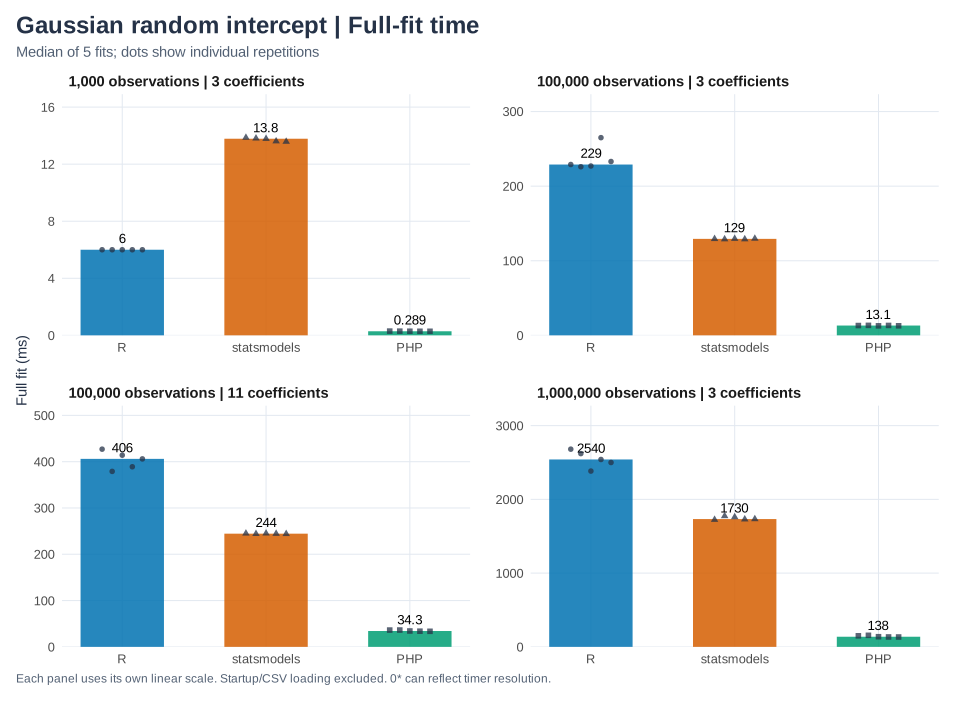
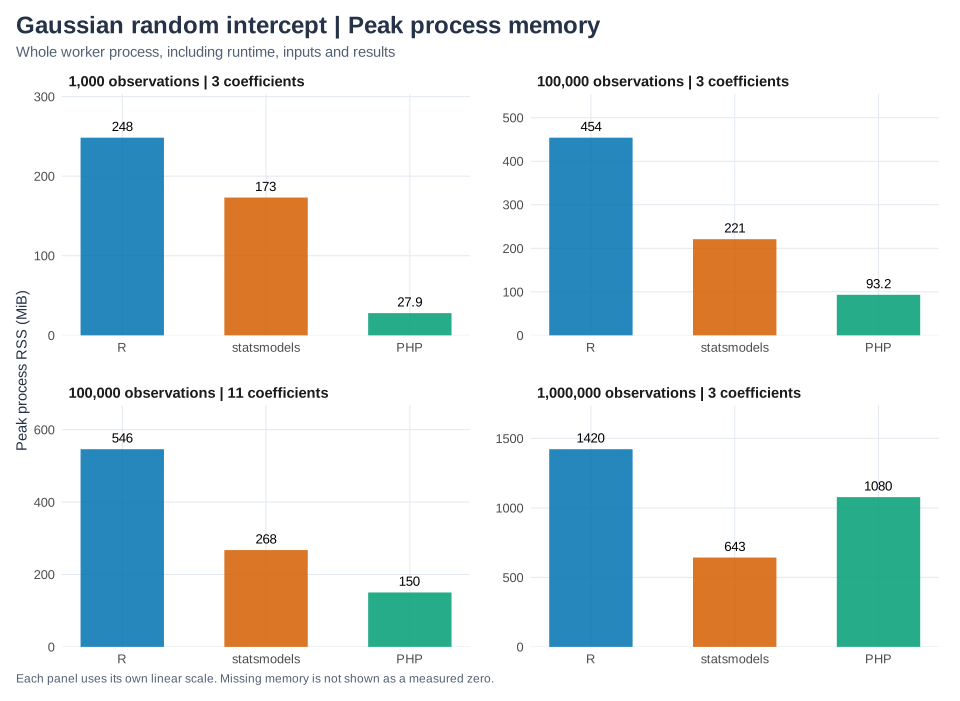
Each panel uses its own labeled linear scale. Order/colors remain R, statsmodels, PHP. Download timing SVG/PNG and memory SVG/PNG.
Native Rust optimization
The first implementation repeatedly whitened and SVD-factorized all n rows at every trial variance ratio. The optimized implementation follows lme4’s penalized least-squares elimination idea: separate within-group deviations from group means and cache an augmented QR square-root summary. Each trial now factors p+1+G rows. Covariance is computed only for the selected solution. The same grid, score root refinements, ML objective, rank threshold, input/output contract and numerical tolerances are retained; this is a computational change. The walkthrough derives the reduction and checks its residual norms numerically.
baseline=json.loads((ROOT/'docs/benchmarks/lmm-baseline-results.json').read_text())
old_cases={(c['n'],c['p']):c for c in baseline['cases']}
comparison=[]
for case in sorted(report['cases'],key=lambda c:(c['n'],c['p'])):
    old=old_cases[(case['n'],case['p'])]
    assert old['data']['sha256']==case['data']['sha256']
    before=old['implementations']['PHP']['median_fit_seconds']
    after=case['implementations']['PHP']['median_fit_seconds']
    comparison.append(dict(observations=case['n'],coefficients=case['p'],
                           previous_full_fit_ms=1000*before,optimized_full_fit_ms=1000*after,
                           speedup=before/after))
display(pd.DataFrame(comparison))
print('Baseline recorded:',baseline['recorded_at'])| observations | coefficients | previous_full_fit_ms | optimized_full_fit_ms | speedup | |
|---|---|---|---|---|---|
| 0 | 1000 | 3 | 1.630750 | 0.288584 | 5.650868 |
| 1 | 100000 | 3 | 219.741292 | 13.142458 | 16.719954 |
| 2 | 100000 | 11 | 1247.759875 | 34.290750 | 36.387652 |
| 3 | 1000000 | 3 | 3180.232500 | 137.511500 | 23.127029 |
Baseline recorded: 2026-10-11T20:32:52.308299+00:00The baseline report preserves all original timings and artifact hashes. These are separate runs on the same machine and identical seeded CSVs, so timing ratios remain subject to system noise. Both reports time complete PHP calls, including conversion and all observation-length outputs. This is native nalgebra QR/SVD, with no BLAS/LAPACK or sparse backend dependency. lme4 uses a general sparse Cholesky implementation; our specialized square-root reduction reuses its mathematical elimination idea while retaining SVD rank checks.
Timing boundaries and methods
Each worker loads one CSV, warms up once and fits five times. Timed calls include estimation, fixed-effect covariance and normal Wald inference, variance components, ICC, likelihood/AIC, all population/conditional fits and both residual vectors, and all conditional group estimates. PHP also validates/copies inputs and converts all output arrays and group/sample metadata inside the timer. Startup, CSV parsing, data generation and final compact JSON serialization are excluded.
R uses lmer REML=FALSE with bobyqa rhoend=1e-10. Python uses MixedLM ML BFGS with gtol=1e-10 and recalculates plug-in GLS covariance to align with the documented convention. Its native joint observed-Hessian covariance is not compared as though it were identical. Rust scans a log-ratio profile grid and refines analytic-score roots with compact weighted SVD GLS fits, after a one-time QR reduction. These algorithms and stopping rules differ. The comparison measures complete declared API behavior, not a single common solver.
display(ordered_table(memory))| observations | coefficients | implementation | CSV_load_seconds | whole_process_seconds | peak_RSS_MiB | |
|---|---|---|---|---|---|---|
| 0 | 1000 | 3 | R | 0.001000 | 0.638906 | 248.421875 |
| 1 | 1000 | 3 | statsmodels | 0.000505 | 0.777184 | 173.156250 |
| 2 | 1000 | 3 | PHP | 0.001109 | 0.044383 | 27.937500 |
| 3 | 100000 | 3 | R | 0.099000 | 2.200085 | 454.265625 |
| 4 | 100000 | 3 | statsmodels | 0.033943 | 1.500582 | 220.968750 |
| 5 | 100000 | 3 | PHP | 0.104874 | 0.228927 | 93.156250 |
| 6 | 100000 | 11 | R | 0.857000 | 4.154999 | 546.281250 |
| 7 | 100000 | 11 | statsmodels | 0.123660 | 2.293741 | 267.578125 |
| 8 | 100000 | 11 | PHP | 0.326796 | 0.592065 | 150.281250 |
| 9 | 1000000 | 3 | R | 2.974000 | 19.689484 | 1422.484375 |
| 10 | 1000000 | 3 | statsmodels | 0.339861 | 11.493968 | 642.750000 |
| 11 | 1000000 | 3 | PHP | 1.045982 | 1.976936 | 1077.390625 |
Whole-process time includes startup/imports, CSV loading, warm-up and all five fits. Peak RSS covers that entire process, not only the numerical solver. PHP’s memory limit is disabled for these large nested arrays. Thread environment variables are set to one, worker order alternates, and runtimes execute separately. Timer resolution, system activity and caches can affect results. See the OLS timing discussion.
Simulation and numerical checks
NumPy RNG seed 20261011 generates correlated study hours and prior scores, independent standard-normal extra predictors, and schools with roughly equal sizes. Outcomes follow
\[y_i=50+1.8\,\mathrm{hours}_i+0.2\,\mathrm{prior}_i +0.5\sum_j\mathrm{extra}_{ij}+b_{g(i)}+\epsilon_i, \quad b_g\sim N(0,6^2),\quad\epsilon_i\sim N(0,5^2).\]
This sample is separate from the saved small teaching dataset. Identical 17-significant-digit CSVs are used by every worker. All coefficient-level fields, variance components, ICC, likelihood/AIC and all group effects are checked. Observation-length outputs are fully materialized, but cross-runtime checks sample ten evenly spaced rows; small fixtures check every row.
Benchmark absolute tolerance is 1e-7. Relative tolerance is 1e-6 for ordinary outputs, 1e-5 for covariance, SE, z-statistics, variance components, sigma and ICC, and 1e-9 for likelihood/AIC. Small saved references use the tighter uniform 1e-7 + 1e-6 × abs(reference) policy.
The first 100,000-row check found R’s between-group variance differed from the analytic-score solution by about 2.6e-6 relative while log-likelihood differed by only about 8e-10. The log-ratio profile score was approximately 2.55e-4 in R, -1.88e-6 in Python and 3.12e-11 in Rust. A flat likelihood and floating-point objective resolution limit independently optimized variance-component agreement; the variance-sensitive benchmark tolerances reflect that measured distinction. They do not replace the closed-form ML check or justify relaxing likelihood agreement. The finite Rust profile grid itself is not a global-optimum proof.
display(ordered_table([dict(observations=case['n'],coefficients=case['p'],implementation=name,
                           largest_absolute_difference_vs_R=max(errors.values()))
for case in report['cases'] for name,errors in case['max_absolute_errors_vs_R'].items()]))| observations | coefficients | implementation | largest_absolute_difference_vs_R | |
|---|---|---|---|---|
| 0 | 1000 | 3 | statsmodels | 0.000002 |
| 1 | 1000 | 3 | PHP | 0.000002 |
| 2 | 100000 | 3 | statsmodels | 0.000124 |
| 3 | 100000 | 3 | PHP | 0.000123 |
| 4 | 100000 | 11 | statsmodels | 0.000014 |
| 5 | 100000 | 11 | PHP | 0.000014 |
| 6 | 1000000 | 3 | statsmodels | 0.000101 |
| 7 | 1000000 | 3 | PHP | 0.000101 |
Reproduce
export PHP=/opt/homebrew/bin/php
export PHP_CONFIG=/opt/homebrew/bin/php-config
cargo build -p php-stats --release --locked
.context/notebooks-venv/bin/python tests/benchmarks/run.py --model lmm
QUARTO_PYTHON="$PWD/.context/notebooks-venv/bin/python" quarto render docs/benchmarks/lmm.qmd
quarto render docs
R requires lme4 as a development package. Use matching PHP tools and .so on Linux. For a quick check preserving the published report, add --cases 1000:3 --repeats 2 --output .context/lmm-smoke.json. Numerical failures abort before publication. Ordinary renders read saved results and do not rerun these timings. See the contract for model and inference limits.
From phpstats/phit@76b22f0.